.png)
“I am an autistic disabled person, I’m trying to go to the doctor.”Why This ICE Encounter Terrifies Disability Communities and What It Reveals About Escalating Federal Force

Updated: Jan 17
By Crystal Jordan
Auesomely You Magazine
Published: 1/15/2026
Pillar Focus: Disability Awareness + Advocacy
I can’t explain the emotions I felt watching this clip.

Hearing her say, “I’m disabled, I’m trying to go to the doctor up there, that’s why I couldn’t move. I am an autistic disabled person, I’m trying to go to the doctor.”broke me to my core. Those words should have changed the entire encounter. Instead, they were ignored.
I cried watching this because this could be my son.
It could be my friend’s child.
It could be any autistic person who doesn’t process fear, authority, or chaos the same way others do.

And the question won’t leave me:
What if they did not comprehend what was happening?
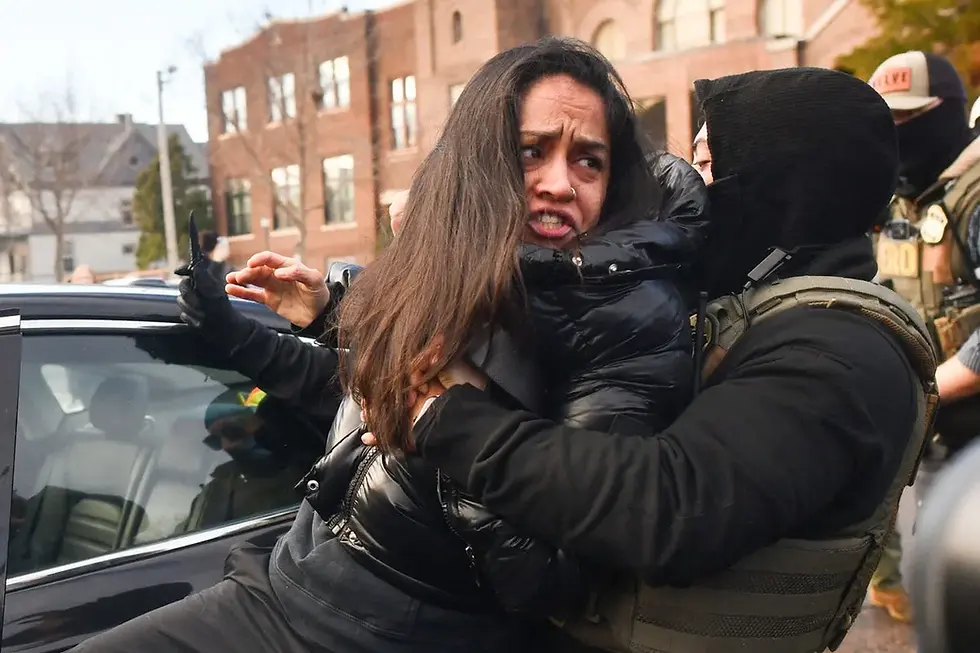
When autistic Americans face law enforcement without proper training and disability awareness, fear does not disappear. It becomes amplified and in some cases, lethal.
“I’m disabled, I’m trying to go to the doctor up there, that’s why I couldn’t move. I am an autistic disabled person, I’m trying to go to the doctor.”

A Broader Pattern of Federal Force
This incident in Minneapolis is not an isolated event. It sits within what critics call Operation Metro Surge, a sweeping federal immigration enforcement operation ordered under President Donald Trump’s latest administration!
Advocates and elected officials have described the operation as the biggest ICE enforcement effort ever carried out, marked by aggressive tactics and widespread disruption to civic life.
One moment that sparked national outrage was the fatal shooting of Renee Nicole Good, a 37-year-old U.S. citizen, by an ICE officer during a federal operation in Minneapolis on January 7, 2026.
Good, a mother of three, was shot multiple times including in the head and chest after federal agents confronted the crowd during the operation. Despite federal claims that the shooting was justified as self-defense, eyewitnesses and local officials have challenged that narrative, and protests erupted across the city and beyond.

In the days following, federal immigration agents were recorded dragging another woman, Aliya Rahman, from her car in Minneapolis while she was on her way to a medical appointment, despite her repeated explanations and disability disclosure. Rahman later said she felt “lucky to be alive.”

These incidents have prompted public outcry, not only from communities directly affected but from civil rights advocates nationwide who warn that the enforcement surge has created heightened fear, especially among vulnerable populations.

What This Means for Disabled Americans
For autistic people and the families who love them, this moment exposes a painful reality: federal law enforcement is too often unprepared to recognize disability and neurological difference, even when it is clearly communicated.
Autistic individuals can struggle with sensory processing, communication challenges, and stress responses that are easily misread as resistance or defiance by officers without proper training. Research shows autistic people are significantly more likely to experience challenging law enforcement encounters because of these misunderstandings making the need for training and accommodation urgent.
If disclosure of autism and disability does not lead to appropriate accommodations in a law enforcement encounter, the individual is left dangerously unprotected.

Law Enforcement at a Crossroads
Federal agencies like U.S. Immigration and Customs Enforcement (ICE) operate under use-of-force policies that allow deadly force when an officer believes a suspect poses an imminent threat of death or serious bodily injury.
But the interpretation of such policies becomes deeply problematic when individuals with disabilities are on the other end of the encounter especially when those disabilities meaningfully affect communication, perception, or behavior.
In the Minneapolis cases, local officials have strongly criticized both the federal narrative and the lack of transparent, joint investigation. The Minnesota Bureau of Criminal Apprehension (BCA) reported that it was initially involved in evidence collection but was later excluded due to federal control over the case, leaving local authorities without full access to the facts.
Political and Social Fallout
President Trump and federal officials have defended the tactics, with Trump even threatening to invoke the Insurrection Act of 1807 to deploy troops to quell protests over the Minneapolis enforcement actions a move that has drawn both legal and public scrutiny.
Critics including local leaders like Minneapolis Mayor Jacob Frey and Minnesota officials say that aggressive federal tactics have escalated tensions rather than enhanced public safety. Lawmakers and civil rights groups have condemned what they call the trauma and terror inflicted on communities, including U.S. citizens who were swept up in enforcement actions.
Polls show a majority of Americans disapprove of the way ICE is enforcing immigration laws in the aftermath of the fatal Minneapolis shooting, reflecting broader concern about excessive use of force and civil liberties violations.
Why This Matters to Autistic and Disabled Communities
For families of autistic and disabled individuals, these events are not abstract news. They are direct threats to safety and dignity.
Autistic people are more likely to be misunderstood in stressful, high-pressure situations, and research confirms they are disproportionately at risk for misunderstandings or escalation with law enforcement. Without appropriate disability-informed training, the risk of injury or death rises dramatically.
This is why widespread reform mandating disability-competent training across agencies, especially at the federal level is not just a policy goal. It is a matter of survival.
A Call for Accountability and Change
At Auesomely You Magazine, we advocate for voices too often silenced and lives too often overlooked. When someone says “I am autistic” or “I am disabled,” the correct response should never be force. It should be:
Pause and assess
De-escalate and accommodate
Communicate with care
A National Call to Action: Federal Disability Training in All 50 States
This is where we draw the line.
We are calling for mandatory, federally required disability and autism response training for all law enforcement officers and first responders in all 50 states with no exceptions.
Every autistic person.
Every disabled person.
Every family deserves to know that when they disclose a condition, it will be met with understanding not force.
This training must include:
Autism-specific de-escalation protocols
Disability disclosure recognition and response
Sensory-aware communication strategies
Nonverbal and alternative communication understanding
Clear protocols for slowing down encounters
Accountability measures when training is ignored
And it must be federally standardized, not optional, not suggested, not dependent on local budgets or leadership.
Because disability does not stop at state lines.
Why This Cannot Be Left to Chance
Autistic and disabled individuals should not have to rely on luck to survive an encounter with law enforcement.
They should not have to hope the officer they meet:
Knows what autism looks like
Understands sensory overload
Recognizes shutdowns vs. resistance
Knows how fear manifests in disabled bodies
Disclosure should trigger protection, not punishment.
When someone says, “I am autistic,” or “I am disabled,” the response should be immediate de-escalation—not escalation.
Anything less is negligence.
This Is About Safety, Not Politics
This is not a partisan issue.
This is not anti-law-enforcement.
This is not anti-government.
This is pro-life, pro-safety, and pro-human dignity.
Training saves lives on both sides of the interaction.
And without it, autistic Americans remain at disproportionate risk of:
Use-of-force incidents
Wrongful detainment
Injury or death
Criminalization of disability-related behaviors
That is not justice.
That is systemic failure.
Our Demand
We demand:
Federal legislation mandating disability-informed response training
National standards enforced across all 50 states
Ongoing recertification—not one-time courses
Public accountability when protocols are ignored
Inclusion of autistic and disabled voices in training design
Nothing about us without us.
From One Parent, One Advocate, One Community
As a parent.
As an advocate.
As someone who knows this could be my child.
I am calling for change in all 50 states.
Because autistic lives are not disposable.
Disabled lives are not collateral damage.
And silence is no longer an option.
At Auesomely You Magazine, we will continue to amplify these stories not to shock, but to change policy.
Seen. Heard. Celebrated.
And protected.
Because autistic Americans and all disabled Americans deserve to be safe, affirmed, and protected by institutions that are meant to serve the public, not terrorize it.
This is not just a law enforcement issue.
This is a human rights issue.
This is a disability justice issue.
And until every public safety professional is trained to recognize and honor disability disclosure, fear will continue to overshadow freedom.
She Has a Name
This was not just a clip.
This was not just another headline.
This was not just “an incident.”
She has a name.
Aliya Rahman.
She is an autistic, disabled woman who clearly stated who she was.
She disclosed her disability.
She said she was going to a medical appointment.
And still, force was used instead of care.
When we talk about policy, training, and accountability, we must remember that these moments happen to real people with real lives. What happened to Aliya Rahman should never happen to anyone especially not someone who did everything right by disclosing their disability.
Aliya Rahman survived.
But survival should never be the standard.
Until autistic and disabled people can safely say “I am autistic” without fear of escalation, restraint, or harm, this country has failed them.
She has a name.
And her name deserves to be remembered.
✨ Seen. Heard. Celebrated. ✨


Comments